 البطريركية المارونية
FINAL STATEMENT of the Synod
أخبار بيانات مجمع الأساقفة
of Maronite Bishops, June 13, 2026
INTRODUCTION
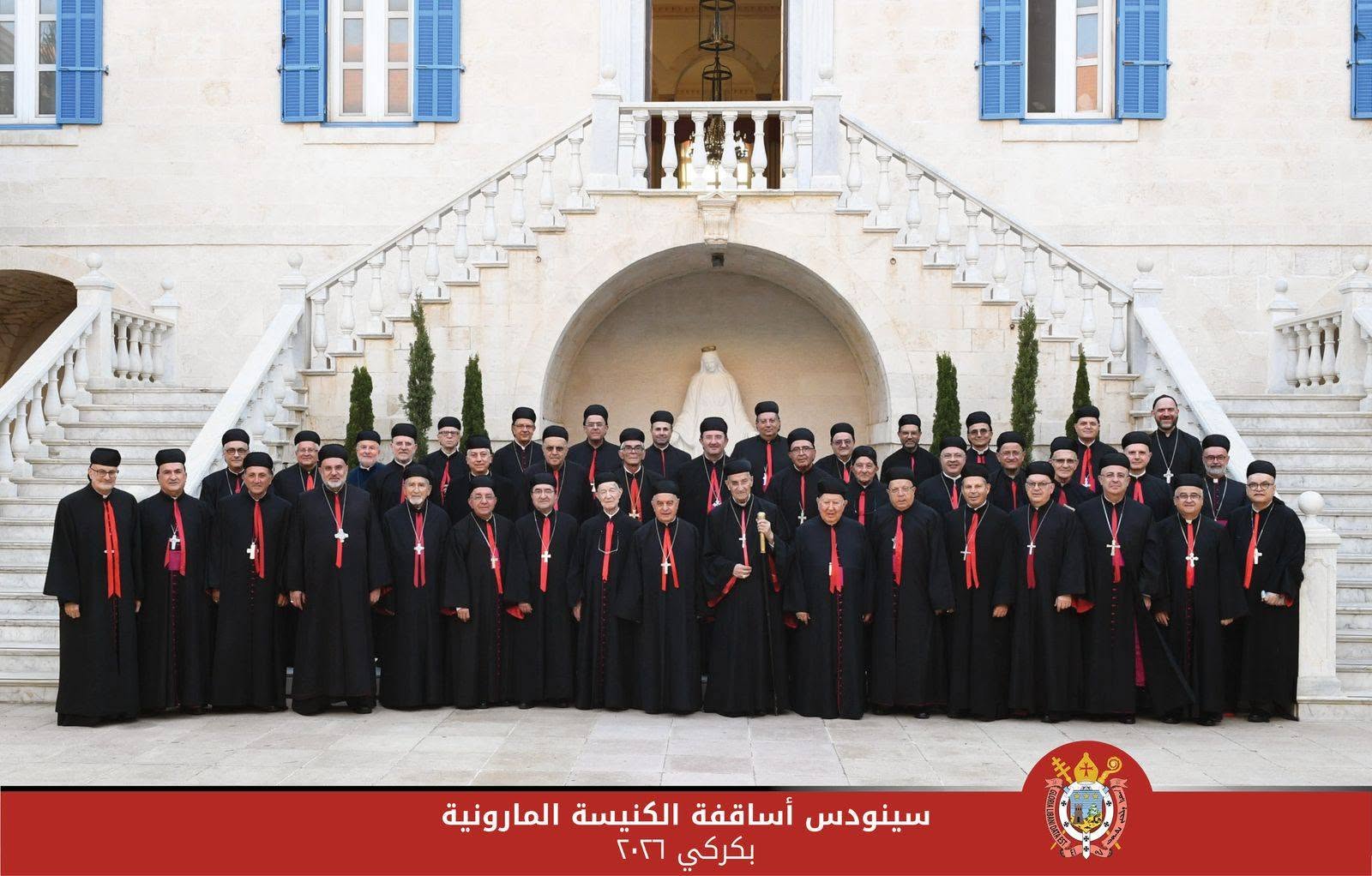
- The Synod of Bishops of the Maronite Church gathered for its ordinary session from June 3 to 13, 2026, at the Patriarchal See in Bkerke. The session was convened by His Beatitude and Eminence, Cardinal Mar Bechara Boutros al-Rahi, Patriarch of Antioch and All the East. Participating in the synod were their Excellencies the Bishops, the Exarch, and the Apostolic Administrator, arriving from dioceses across Lebanon, the Patriarchal domain, and countries of the expansion (diaspora). They carried in their hearts the affairs, concerns, and aspirations of their sons and daughters at a time when their Church in Lebanon and the region suffers from the consequences of a destructive war that has exacerbated the bleeding of continuous emigration.
In the first phase, from June 3 to 6, 2026, the Fathers participated in a spiritual retreat. The sermons were delivered by Father Michel Khoury, the Antonine Vicar General, on the topic: “The Bishop’s Calling: A Journey of Continuous Growth in Christ”. In the second phase, from June 8 to 13, 2026, they participated in the work of the Synod. His Beatitude and Eminence introduced the proceedings with an address welcoming the Fathers, thanking God for the Maronite Church’s witness to Christ in the world, and reviewing the agenda.
After praying together and listening to the voice of God and what the Holy Spirit is saying to their Church, the Fathers thanked God for the grace of a new holiness manifested in the declaration of the Venerable Patriarch Elias Howayek as Blessed. His beatification will be celebrated at the Patriarchal See in Dimane on July 25, 2026, and his annual feast will be celebrated on the fifth of June, the anniversary of his priestly ordination.
Subsequently, they studied ecclesiastical, pastoral, social, and national matters, discussing them in a fraternal spirit and synodal communion characterized by mutual listening, frank dialogue, and shared discernment, taking the appropriate ecclesiastical and pastoral measures.
At the conclusion of the assembly, they issued the following statement:
FIRST: ON ECCLESIASTICAL MATTERS
A. Living Synodality in the Maronite Church
- The members of the Synod considered that their Maronite Church today, amidst global transformations and challenges, is called more than ever to walk—pastors and people alike—under the guidance of the Holy Spirit in a spirit of love, humility, and evangelical courage, so that it remains a sign of hope and a living witness to Christ’s presence in the world.
Therefore, they proceeded to study the agenda items using a synodal methodology, aligned with the general atmosphere of the Catholic Church. This allowed the Holy Spirit to guide their thinking through the method of “Conversation in the Holy Spirit” and discussions during plenary sessions, granting them the grace of deep listening, freedom of heart, wisdom of discernment, and mutual trust, thereby renewing their episcopal service to their people in the image of Christ the Good Shepherd.
- During the initial days, they listened to six presentations addressing the problem of “Episcopal Collegiality and Synodality – Reality and Aspirations”. The first presentation focused on the reciprocal relationship between episcopal collegiality and synodality, and the practice of episcopal collegiality within the Maronite Church. This practice holds a dual character, linked on one hand to the Maronite experience in its Antiochene depth, and on the other hand to its subsequent ecclesiastical connection to the Roman Apostolic See.
Other presentations highlighted the experiences lived by some members during their participation in the Sixteenth General Assembly of the Synod of Bishops held in Rome (2023–2024), and the rich fruits they harvested and brought back to their Church. The sessions also addressed confronting the challenges of synodality, which requires transitioning from institutional synodality to synodality as a spirit, way of life, and ecclesiastical discernment, alongside strengthening the role of the laity as full members who share co-responsibility in the Church’s mission and witness.
The final presentation dealt with the aspirations of a “Prophetic Church in the World and for the World.” This perspective views the world, with its positives and negatives, as the human scope into which Jesus Christ entered when He “became flesh and dwelt among us”. It emphasized that the Church must avoid falling into a state of dissolution and identification with the world, as well as avoid separation from it out of fear of slipping into its crooked ways.
- Working together in small groups through the “Conversation in the Holy Spirit” method, they discovered that the synodal approach introduced positive dynamics into their interactions, fostering mutual listening, frankness, and trust. They thanked God that they, along with the people of God and all the baptized, form one body whose head is Christ, wherein the Holy Spirit distributes gifts to everyone according to their capacity, calling them to serve with their given gifts in harmony and participation with other members.
Consequently, they agreed to adopt the synodal method and generalize it across their dioceses, structures, movements, and ecclesiastical associations. They also decided to appoint a committee dedicated to following up on the synodal journey within the Maronite Church.
B. Emerging Ecclesial Communities in the Maronite Church
- The Fathers listened to a summary of the detailed report submitted by the Episcopal Committee tasked with studying the status of emerging religious communities within the Maronite Church, which had recommended the appointment of a Patriarchal Committee and outlined its duties.
The Fathers discussed the conditions of these communities and emphasized the necessity of accompanying them spiritually, ecclesiastically, and theologically on their journey. They addressed the ongoing complications, particularly on social media, involving the founders and certain members of these communities. They affirmed the mandatory nature of their formation according to the teachings of the Catholic Church and recommended the immediate establishment of the proposed Patriarchal Committee to begin its work as soon as possible.
C. Liturgical Reform
- The Fathers reviewed the work of the Patriarchal Liturgical Committee, presented by its chairman. The report noted that the committee recently appointed specialized sub-committees to work on: Preparing texts for funeral and ordination rites; Preparing the Fenqitho book (the book of feasts for the Lord and certain saints); Preparing the book of blessings; Arranging the texts for the rites of Baptism, Chrismation (Myron), Engagement, and Marriage.
These efforts follow the new directives of the Holy See, which emphasize adopting the core text in the Syriac language and relying on the principle of organic development of liturgical texts established by the Second Vatican Council and adopted by the Maronite Patriarchal Synod. This principle entails launching from a stable liturgical tradition while ensuring its logical contemporary growth.
Subsequently, certain items from the Liturgical Directives and the Maronite Calendar were put to a vote, and a promise was made to send a draft of the Liturgical Office (Prayer of the Faithful) for the Season of the Holy Cross to the bishops for their feedback.
D. Priestly Formation
- The Fathers reviewed reports from the seminaries responsible for preparing the priests of tomorrow, namely: the Maronite Patriarchal Seminary in Ghazir, St. Anthony of Padua Seminary in Karm Saddeh, and Our Lady of Lebanon Seminary in Washington, D.C., in addition to the Pontifical Maronite College in Rome. They also reviewed the report of the committee tasked with ensuring the ongoing formation of priests. They praised the efforts made to form priests who witness to Christ in today’s world through love, service, and vigilance, and then listened to three presentations.
The first presentation addressed the experience of living synodality at the Maronite Patriarchal Seminary in Ghazir in communion with the bishops, the local Church, the formation team, and the seminarians. It highlighted community life as a school for priestly communion, as well as the apostolic dimension and openness to society and parishes. It concluded that experience proves synodality is not a passing project or a situational event, but a continuous path calling for listening, communion, and shared discernment.
The second presentation outlined a project for the formation of priests for diaspora dioceses, where the majority of Maronites reside today and where there is an urgent need to form priests who interact with major global transformations. This requires human, academic, and pastoral qualities adapted to the new reality. After presenting an integrated formation program, a request was made to the bishops of dioceses in Lebanon and to the Maronite Patriarchal Seminary to cooperate in forming and accompanying seminarians to ensure pastoral and ecclesial experience in diaspora countries.
The third presentation focused on the spiritual dimension of priests’ lives and ministry, explaining the signs and causes of weakness in a priest’s spiritual life. It offered suggestions for renewing spiritual life, concluding that the sons and daughters of our parishes do not just need successful priests, but priests filled with the Holy Spirit who witness, pray, weep with those who weep, and rejoice with those who rejoice.
E. Legal Affairs and the Service of Justice
- The Fathers reviewed reports from the bishops tasked with overseeing the service of justice in our Maronite courts of first instance and appeals. They praised the efforts made to receive litigants, listen to them, and accompany them before proceeding with lawsuits, aiming to propose reconciliations, reduce tensions, consider the best interests of children, and expedite rulings. They also listened to a presentation outlining a mechanism to limit the increase in requests for marriage annulments and amicable agreements regarding the effects of annulment.
The Fathers praised the efforts of those working in courts, listening centers, reconciliation centers, and mediation offices within dioceses and the Patriarchal Curia to resolve marital disputes before resorting to court. They also called for activating marriage preparation centers and accompanying newlyweds in the dioceses.
F. Administrative and Pastoral Affairs
- The Fathers reviewed reports from the offices of the Patriarchal Curia across all its branches: Media and Digital Communication, Marriage and Family Ministry, Women’s Ministry, Youth Ministry, Heritage and Cultural Properties, Ministry for Persons with Disabilities, and Relations with Lebanese State Institutions and Foreign Embassies.
They also reviewed reports from Patriarchal institutions, including: the Patriarchal Foundation for Comprehensive Development, the Maronite Foundation in the World, and the Maronite League.
They praised the immense efforts of those leading these offices and institutions—including active laity, bishops, priests, monks, and nuns—who form the core of the Church-Communion. Operating under the supervision of His Beatitude the Patriarch, they work to deliver the spiritual, humanitarian, social, and national service required of them, reflecting the face of a Church witnessing to Christ and serving humanity.
SECOND: ON SOCIAL AFFAIRS AND THE SERVICE OF CHARITY
- The Fathers listened to a report from the Coordination Committee for the Service of Charity, which brings together all church associations under Caritas Lebanon. The report outlined the work of charity service within the Church and posed the question: How can the service of charity become a place for mutual listening, dignity, participation, and encountering Christ in the poor? It noted that the most dangerous risk facing charity work is its transformation into mere technical execution or the distribution of aid, whereas its true calling is to stand alongside the suffering and needy of our people, listening to their pain and preserving their dignity. The report then addressed the experience of the Coordination Committee and the cooperation between associations and institutions in supporting brothers and sisters remaining steadfast in their villages in the South, as well as displaced individuals. Finally, it touched upon what people expect from the Church today and what the Church can provide in this field.
- The Fathers then discussed the situation in Lebanon, which has become an economically and socially devastated country since 2019, compounded by the Beirut port explosion and the ongoing war between Israel and Hezbollah imposed on Lebanon and its people. This has led to massive loss of life, with hundreds of women and children falling victim, the displacement of hundreds of thousands of citizens, and the destruction of numerous properties and institutions. Furthermore, the emigration of youth and families has worsened as livelihoods vanished, particularly after social security dissolved and funds were trapped in banks. People’s priorities have shifted to merely living with dignity and peace of mind by securing shelter, schooling, employment, and healthcare.
- The Fathers are fully aware of the gravity of the current situation, noting that many families are in a miserable state, requiring food, medicine, healthcare, and shelter. However, most of their sons and daughters specifically ask that the Church support their steadfastness, preserve their dignity, and grant them hope for the future. Despite its limited resources, the Church works to unify energies, gather associations and institutions, and redouble efforts in the service of humanity, offering the maximum possible to secure a space of spiritual, social, and human safety.
Therefore, the Fathers call upon all dioceses and church institutions, spearheaded by Caritas Lebanon, to exert efforts and sacrifices to secure what is essential for a dignified life for our people. They request their sons and daughters in diaspora countries to continue supporting their families and relatives in Lebanon, Syria, and Middle Eastern countries, and to activate investment opportunities to help limit youth emigration and encourage them to remain in their homelands.
- The Fathers demand that the State and its institutions fully assume their educational, social, and health responsibilities toward citizens by securing health, educational, and social safety nets, and by paying dues owed to service institutions such as free schools, hospitals, and shelters. They also call upon officials, especially financial authorities, to act quickly to restructure banks and public debt, reform the banking sector, and guarantee that depositors recover their funds so that the economic wheel can turn and Lebanon can rise.
THIRD: ON NATIONAL AFFAIRS
- The Fathers listened to two presentations regarding the Maronite Church’s vision for state-building. The first presentation explained the principles laid down by Blessed Patriarch Elias Howayek for building the State of Greater Lebanon, adding that speaking about Patriarch Howayek means speaking about the identity of Lebanon as an entity, a state, and a message, and about the foundational phase of a unified Maronite political thought and the national vision of the Maronite Patriarchate. The second presentation outlined the current aspirations of the Maronite Church, stating that there is a close link between the Maronite Church—specifically its Patriarchs—and the State as an entity in Lebanon. It noted that a timely opportunity exists today to restore the natural role of the State and the role of the Church in light of major internal transformations and relations with the Holy See. The Church must take the initiative and propose a comprehensive vision drawing from the Maronite Patriarchal Synod.
Following an extended discussion in light of current situations in Lebanon, the region, and the world—and at a time when Lebanon’s identity, entity, and message appear to be in danger—they established the following recommendations:
- The Fathers reaffirm the principles established by Blessed Patriarch Elias Howayek for building the State of Greater Lebanon, which are:
First: Restoring Lebanon’s historical borders (The Legal Entity of the State).
Second: National Sovereignty (The Neutral State).
Third: Pluralism and Coexistence (The National Covenant State).
Fourth: The Parliamentary System (The Modern State).
Fifth: Patriotism (The Civil State and the State of Law and Justice).
- The Fathers renew their confirmation that the Lebanese entity is a definitive homeland for all its sons and daughters. It does not operate on the logic of victor and vanquished, but on actual national partnership and unified living under a free, sovereign, and just state. Lebanon is one, in land and people from its furthest south to its furthest north; all Lebanese form a single family rich in diversity and pluralism, and they are a single community of communities—as Pope Leo XIV stated—united by a single language, the language of hope.
- The Fathers call upon all Lebanese for a national alignment around the State in accordance with the Constitution and the National Pact, as required by the national partnership among its components. They stress the necessity of supporting the State, exclusively alongside the Lebanese Army and security forces, so it can fulfill its duties, assume its responsibilities, and extend its authority over all its territories. They call on citizens to endorse the State in its diligent efforts and in the Lebanese-Israeli negotiations led under American auspices and with Arab and international support, to formulate solutions that protect Lebanon’s rights, safeguard its full and undiminished sovereignty over its land, and achieve a lasting and comprehensive peace.
- The Fathers address the officials of the Lebanese State, speaking to them through the words of Blessed Patriarch Elias Howayek:
“You who are guardians of affairs, you who are judges of the earth… you are committed, in your official capacity by virtue of your mission, to pursue the public interest. Your time is not your own, your work is not your own, but belongs to the State and the nation you represent. You were appointed to bring happiness to the homeland, so you cannot sacrifice its interests without insulting justice and gravely violating what the duty of loyalty demands of you.”
CONCLUSION
- In conclusion, we, the Fathers of the Synod, turn to our children in Lebanon, the countries of the Patriarchal domain, and the expansion, and say to them:
You seek a Church that is close to you, that listens to you, accompanies you, and shares your daily anxieties, concerns, pains, hopes, and aspirations.
You seek a Church that preserves your dignity, supports you in remaining steadfast on your land, and serves as a sign of hope for you in Christ Jesus in days of distress.
You seek a synodal Church whose people walk together toward the Kingdom, guided by the Holy Spirit, in mutual listening, dialogue, discernment, and shared responsibility in carrying out the mission across the wide world with a Maronite flavor.
You ask us to be shepherds in the likeness of Jesus Christ, witnessing to Him through our pastoral love for you and our service in humility, sacrifice, and self-giving.
Let us look together, as His Holiness Pope Leo XIV told us during his visit last December, toward “the small lights shining in the night, and the small buds and seeds being sown in the garden of this barren historical time”.
Among the seeds that the Lord Jesus Christ continues to sow in our Holy Land, a sign of Divine Providence has come to us in the beatification of Patriarch Elias Howayek. He believed that the Holy Spirit never ceases to work in the Church no matter how severe the difficulties. Today, along with His Holiness Pope Leo XIV, he says to us: “O Great Lebanon, arise and stand!”
Therefore, do not be afraid, the Lord Jesus Christ tells us, “I am with you always, until the end of the age.”
Let us ask God, through the intercession of the Virgin Mary, Our Lady of Lebanon and our companion throughout history, and all our saints—especially Blessed Patriarch Elias Howayek—to make us apostles of love, prophets of hope, and peacemakers.
* * * * *
Recommendations and decisions adopted during the Synod of June 2026
Recommendations
- Adopt, implement, and generalize the synodal method in the eparchies and religious institutes, and establish a synodal commission in each eparchie and each religious congregation.
Decisions
- His Beatitude the Patriarch will appoint a synodal commission responsible for working along two axes:
- Strengthening the synodal dimension at the level of the Maronite Church, by supporting the implementation of the guidelines contained in the final Document as well as in the document “Paths for the implementation phase of the synod.” This commission will encourage the various ecclesial bodies to adopt methodologies based on listening, discernment, and participation in decision-making processes, in order to ensure the continuity of the synodal path and its effective deployment in the various dioceses and institutions.
- Ensuring the follow-up of the application of the decisions of the ordinary session of the Synod of Maronite Bishops of June 2026, and contributing to the rooting of a common synodal style of work based on participation, mutual trust, and community discernment, listening to the Holy Spirit and the People of God.
- Consolidate the Secretariat of the Synod by providing it with adequate human and administrative resources, so that it ensures the preparation of synod meetings, the documentation of its work, the follow-up of the application of its decisions, and the safeguarding of its archives, thus contributing to strengthening the continuity, co-responsibility, and effectiveness of the synodal approach among the bishops.
- The Secretariat of the Synod will collaborate with the synodal commission, the commission for national affairs and the purification of memory, with a view to preparing a Maronite Patriarchal Synod dedicated to the presence of the Maronite Church in Lebanon, the Middle East, and the world.
- His Excellency Bishop Maroun Ammar is entrusted with the implementation of the recommendations appearing in the report of June 2022 concerning emerging religious and ecclesial communities. He is requested to present to the Permanent Synod, within one month, a detailed proposal concerning the composition of the envisioned commission as well as its operating procedures, with a view to its approval.
- The atriarchal Commission for liturgical matters will present a specimen covering a single liturgical season in the Prayer of the Hours and will transmit it to the members of the Synod in order to gather their observations and opinions.