 البطريركية المارونية
The Council of Maronite Bishops Appeal
أخبار بيانات مجمع الأساقفة
Maronite Patriarchate – Bkerki
Wednesday 06/05/2026
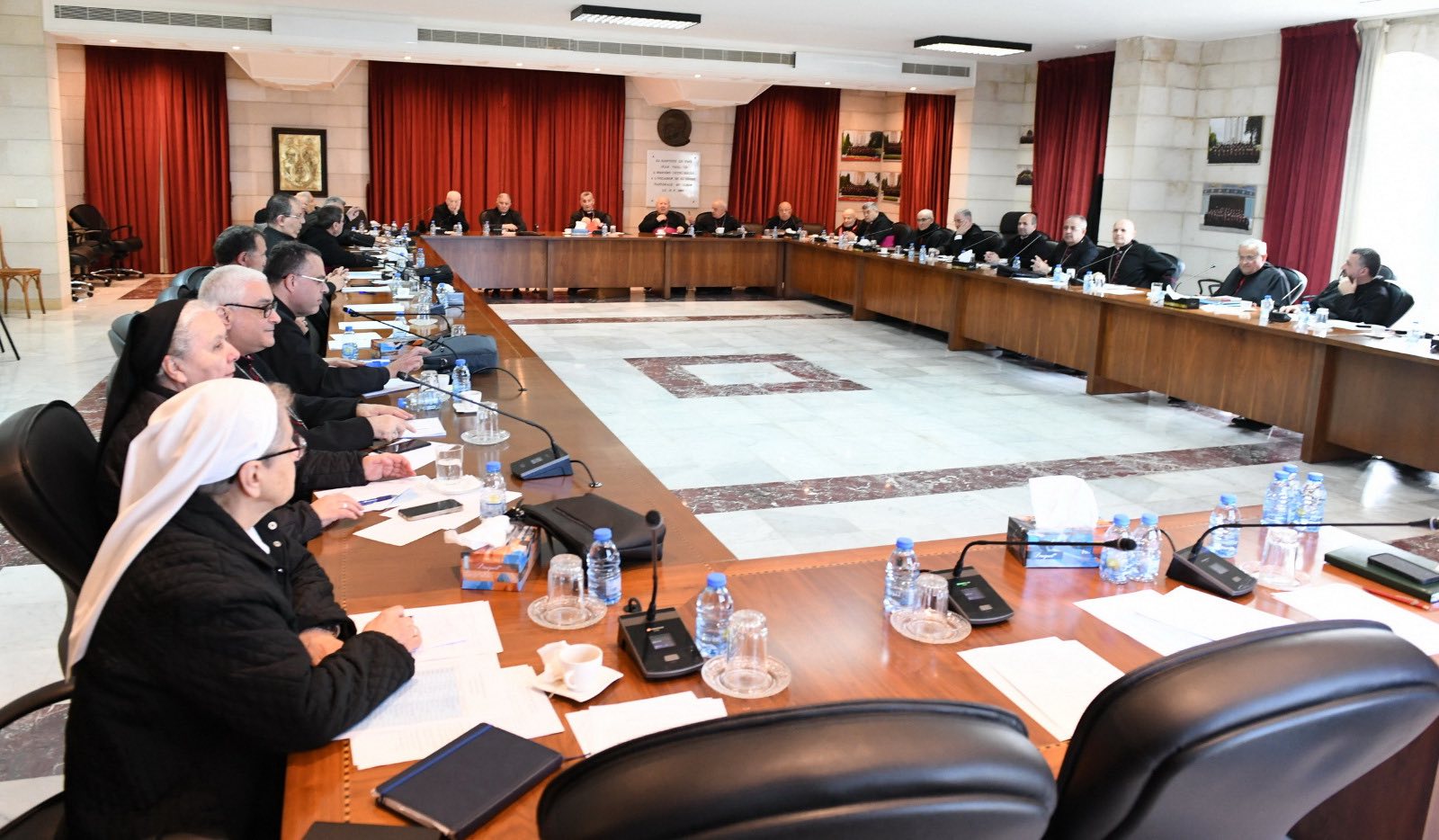
The Council of Maronite Bishops, Major Superiors, and Superiors General held their monthly meeting on May 6, 2026, under the presidency of His Beatitude and Eminence Cardinal Mar Bechara Boutros Al-Rahi. This day coincides with the commemoration of the Martyrs of the Nation. The Council therefore pays tribute to their sacrifices unto martyrdom for the preservation of Lebanon, the homeland and the state, as a free, sovereign, pluralistic, and independent country owing allegiance to none but itself. At the conclusion of the meeting, the Council issued the following appeal:
First – On the Current Reality
In light of the critical historical phase Lebanon is undergoing, where internal challenges intersect with unprecedented regional and international transformations, and in harmony with the position expressed by the President of the Lebanese Republic, General Joseph Aoun, guardian of the Constitution, on April 17, 2026, as well as with the recent decisions of the Council of Ministers chaired by Judge Dr. Nawaf Salam defining the general policies of the state, the Council affirms that Lebanon is not merely a transient political entity born of circumstance. Rather, it is a message of human and civilizational presence founded upon freedom, pluralism, and coexistence, as enshrined in the Lebanese Constitution through the establishment of Greater Lebanon.
Proceeding from this understanding of Lebanon’s identity and role, the Council believes that the present phase requires all Lebanese state institutions to fully assume their sovereign responsibilities without ambiguity or duality, as is the case in all sovereign states. It also calls for strengthening citizens’ trust in the state through effective accountability mechanisms, transparency, and the reinforcement of the rule of law.
Second – On the Entity and Identity of Lebanon
The Council renews its affirmation that the Lebanese entity is final and definitive for all its daughters and sons. It is not founded upon domination, but upon genuine partnership; not upon temporary alignments, but upon shared life within a free, sovereign, and just state. Protecting this entity requires shielding it from all forms of entanglement in the conflicts of others, regardless of their source, defending the entirety of its territory against any aggression, and restoring Lebanon to its natural role as a meeting point between East and West and as a permanent and open space for dialogue.
Third – On the Constitution and the National Pact
The Council stresses that the Lebanese Constitution and the National Pact constitute the governing framework of national life and the sole reference for organizing powers and
relations among institutions. The full and non-selective implementation of the provisions of the Taëf Accord remains the essential gateway to rebuilding an inclusive state, consolidating the principle that arms must be exclusively in the hands of the state, and strengthening institutions over imposed realities. This lays the foundation for a state animated by the spirit of citizenship, embracing diversity and guaranteeing equality among all its daughters and sons within the unity of the Lebanese entity. As for the unprecedented and inflammatory media campaigns, as well as the rhetoric of accusations of treason and intimidation, they serve only the enemies of Lebanon at the expense of the state and society alike.
Fourth – On Arab and International Legitimacy
The Council affirms that Lebanon’s commitment to Arab and International legitimacy constitutes a fundamental pillar in the process of restoring its full sovereignty. In this context, Lebanon remains committed to the relevant international resolutions, particularly UNSC Resolutions 1559, 1680, and 1701, as well as to the resolutions of the League of Arab States and the Arab Peace Initiative proclaimed in Beirut in 2002, which embodies a collective vision for achieving just, comprehensive, and lasting peace in the region. This dual commitment reflects Lebanon’s natural positioning within both its Arab environment and the international order, and it forms the basis for restoring its role as an active and unifying state for all components of society under the Constitution and the law.
Fifth – On Lebanon’s Role in Its Surroundings
The Council believes that Lebanon is called upon to reclaim its role as a space for dialogue and civilizational interaction, far removed from the logic of open arenas and armed conflicts that have afflicted the region for more than half a century. Such a role can only be fulfilled through a strong and sovereign state capable of managing its foreign relations according to its supreme national interests.
Sixth – On the Path of Peace and Neutrality
In light of the major transformations unfolding in the region and the world, the Council emphasizes the importance of approaching negotiations with Israel under Arab and international sponsorship in a manner that serves Lebanon’s supreme national interest and contributes to consolidating security and stability. The alternatives pursued over decades have produced occupation instead of liberation, dependency on foreign powers instead of sovereignty, and subjugation instead of freedom and dignity. The Council further affirms that returning to the 1949 Armistice Agreement constitutes a foundational step upon which this process may be built, while continuing toward a sustainable peace. It also stresses the necessity of linking the peace process with the consecration of Lebanon’s neutrality through
an international decision that safeguards its sovereignty and distances it from axis-based conflicts for which the Lebanese people continue to pay the price.
Seventh – On the Concerns and Priorities of the People
Since 2019, Lebanon has been suffering from a devastating economic and social collapse. In recent years, repeated wars have resulted in immense human losses, including hundreds of women and children, as well as widespread destruction of property and institutions and massive displacement of citizens. Youth emigration has intensified, livelihoods have vanished, social protections have evaporated, and citizens’ savings have remained trapped in the banking system. The overwhelming majority of Lebanese people do not wish to be drawn into endless wars, the wars of others at the expense of people’s lives, safety, and dignity. Their priorities are to live with dignity and peace of mind at home, in schools, at work, and throughout public life, rather than amid armed conflicts.
Conclusion
The Council reaffirms that the present moment is a decisive historical turning point. It calls for courageous and responsible national positions rooted in Lebanon’s supreme interest, national security, and the human security of its people, putting an end to hesitation and incomplete or temporary settlements. The Council renews its support for all efforts undertaken by the President of the Republic, the Lebanese Government, and Parliament aimed at ending the war, restoring every inch of Lebanese territory, launching reconstruction, ensuring the return of the displaced, detainees, and exiles to Israel, consolidating state sovereignty, and restoring Lebanon to its natural place among nations. The Council also extends its gratitude to the brotherly Arab States and the friendly International Community for their continuous support and commitment to rescuing Lebanon, accompanying its path toward recovery, and restoring its historical and civilizational identity and mission. The Council emphasizes that this phase requires firmly establishing a state of citizenship that embraces diversity as an irreversible and final choice. Finally, the Council reiterates that Lebanon, in its historical vocation, is called to serve as a model of living-together and a witness to the possibility of building a free, sovereign, just, and independent state capable of transforming pain into the hope of a genuine national resurrection.
Appeal of the Council of Maronite Bishops and of the General Superiors and the General Superiors in different languages
Arabic
https://bkerki.org/news-article/the-council-of-maronite-bishops-appeal-ar/
English
https://bkerki.org/news-article/the-council-of-maronite-bishops-appeal/
French
https://bkerki.org/news-article/le-conseil-des-eveques-maronites-appel/
Italian
https://bkerki.org/news-article/il-consiglio-dei-vescovi-maroniti-appello/
Spanish
https://bkerki.org/news-article/el-consejo-de-los-obispos-maronitas-llamamiento/
Portuguese
https://bkerki.org/news-article/o-conselho-dos-bispos-maronitas-apelo/
German
https://bkerki.org/news-article/der-rat-der-maronitischen-bischofe-aufruf/
Greek
https://bkerki.org/news-article/the-council-of-maronite-bishops-appeal-gr/